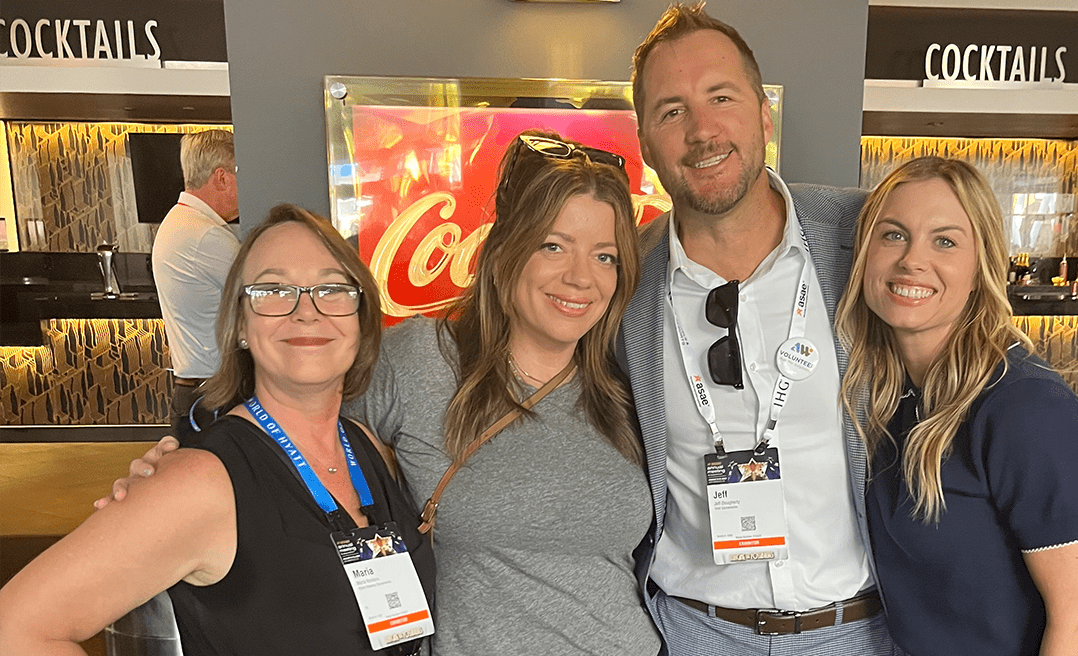
I was at dinner recently with a friend, and we were comparing travel calendars for next year. We’re both planning to attend our professional association’s national conference in August.
She hesitated before saying, almost apologetically, “I’m kind of embarrassed how much I look forward to this conference.”
I told her not to be embarrassed – I look forward to it every year!
Not necessarily because of a particular keynote or session. I look forward to it because it brings me back into a room with my people.
When you’re responsible for leading any kind of change, whether that’s in a classroom, a district office, or a non-profit, much of the decision-making happens alone, and you rarely get to compare notes in real time with people facing the same dynamics. That’s what I value most about an in-person conference: proximity to my existing network and new connections.
What a Conference Actually Does
Of course, as executive director of CALIE, I also care about strong programming, and I know structured sessions matter. At CALIE, we invest time designing learning experiences that are timely and practical. But I also understand that the most important outcomes of a conference won’t always be captured in session evaluations, since they often emerge in conversations between sessions. How do you quantify what you learned in exchanges that begin with, “Have you tried this?” How many times have you returned from a conference with the realization that a problem you thought was unique to your district is actually systemic?
From where I sit, a conference is about creating the spaces for those conversations to happen.
Educators operate in environments that demand constant responsiveness with little, if any, protected space for reflection. When we bring people together intentionally and remove them from the daily grind of their work – even briefly – things change. People test ideas out loud and are more candid about what works and what doesn’t. That shift is subtle, but it’s important.
Why Convening Matters Right Now
Convening becomes even more important when the landscape is shifting. Right now, education leaders are making decisions about AI integration, shrinking budgets, interoperability, instructional strategy, and community trust. A conference is not only a place to learn about the latest tools, techniques, or products, but also to connect with your peers about how they are using these resources to solve similar problems. That is Spring CUE’s role.
It is part of a broader ecosystem CALIE is building year-round, through our certification programs, partnerships, Live Labs, and leadership development work. But Spring CUE is the moment when that becomes visible in one in-person space. The ideas we are testing throughout the year come together, and so do the people responsible for implementing them across schools and districts.
Looking ahead, that matters even more because the questions facing education are not getting easier. If anything, they are becoming more interconnected, and the need for leaders who can think across roles is only growing; coming together is how we strengthen that capacity.
What You Bring Back
Every time I come home from a conference, I’m exhausted, but in the best way. My notes app is full, and I have more ideas than I realistically have time to implement. It’s the kind of exhaustion that comes from being fully engaged. I leave with renewed excitement for my work and a clearer understanding that the challenges we’re navigating are shared, which makes them feel more solvable.
My friend felt embarrassed because she was thinking of attending the conference as an indulgence rather than a responsibility. I see it differently! We should feel encouraged to find joy in our professional responsibilities. When you are in a room full of people who care about improving teaching and learning and who are willing to wrestle with hard questions together, you are better supported to keep moving forward and continue making an impact.
Spring CUE is that kind of room.
I am so lucky to help build it, and I hope you will join us.