If It’s Not Grounded in the Classroom, It Won’t Hit

During a recent conversation at School2Home, I found myself returning to a line I’ve said often,
but one that feels especially urgent right now: “If the work is not grounded in a classroom with teachers and students, it’s not going to hit.”

That idea keeps resurfacing as education grapples with big, sometimes conflicting signals: calls
to reduce screen time, cell phone bans, increasing scrutiny of edtech spending, and a growing
push toward outcome-based purchasing. Taken together, these aren’t signs that schools are
“anti-technology.”

They’re signs that leaders are asking for clarity. They’re asking: What is this
technology actually doing for learning, and for whom?

Usage data tells us what was accessed or accomplished in a platform, but not what changed.
Many tools do offer richer metrics around student progress, levels gained, or skills practice. That
data is valuable, but it still reflects performance within a platform. It does not tell us how
instruction evolved, how students applied learning in other contexts, or whether the tool
supported deeper understanding across classrooms and learner groups.

This is a long-standing problem that most educators recognize immediately. Professional
learning rarely adapts over time to match what teachers actually need once a tool meets the
reality of the classroom. An implementation kickoff or training series is delivered, and that
becomes the end of the support story. From there, tools often fall into one of three categories: a
handful of teachers love them, classrooms use them unevenly, or usage quietly drops off.

What’s missing in nearly every scenario is a system for measuring whether the tool is improving
learning and whether it’s doing so equitably across classrooms and student groups. We rarely
apply the same lens to educators: assessing how their understanding, confidence, and
implementation evolve over time, and adapting professional learning to meet those shifting
needs. In other words, we expect adaptive learning for students but design static systems for
adults.

Through my work with schools, districts, and statewide initiatives at CALIE, I’ve seen this
pattern repeat regardless of context or scale. The issue isn’t that educators don’t care about
impact. It’s that we’ve built systems that equate implementation with access and success with
activity. In doing so, we’ve avoided the harder questions about instructional alignment, learner
experience, and real outcomes.

This is where grounding innovation in classrooms matters.

Grounded innovation requires us to broaden how we evaluate edtech. Consider a common
scenario: a district adopts a digital curriculum tool that shows high login rates across schools.

From an IT perspective, the tool appears successful, but a closer look reveals uneven
instructional use, limited impact for multilingual learners, and wide variation in teacher confidence. Without examining classroom practice, student feedback, and evidence of learning,
those disparities remain invisible and unaddressed.

Another scenario plays out in professional learning. A district provides strong initial training at
rollout, but ongoing support is minimal. Teachers who are already comfortable with technology
adapt and experiment. Others struggle quietly or abandon the tool altogether. In some
classrooms, tools are used without a clear understanding of their instructional intent, leading to
practices that can reinforce misconceptions, limit access for certain learners, or even work
against the outcomes the tool was designed to support. Over time, the system unintentionally
rewards early adopters while widening gaps in implementation and student experience. The
data may show activity, but it doesn’t show equity.

What these examples point to is a necessary shift: professional learning must be treated as an
ongoing infrastructure, not a one-time event. If we want technology to deliver on its promises,
we must design support systems that evolve alongside classroom realities. That may mean
investing more deeply in fewer tools, aligning professional learning with instructional goals, and
creating feedback loops that include teacher voice, student experience, and evidence of
learning.

If we want technology to make a meaningful difference for learners today, the work starts with
more intentional investment—not in more tools, but in implementation, impact, and integration.
We can do this while also addressing the technology overwhelm many teachers and students
are experiencing. More screen time does not equal more learning, and it never has. When
education innovation starts with people—teachers, students, and real classroom practice—we
gain clarity about what to keep, what to strengthen, and what to let go. This is the work we are
committed to at CALIE, and we invite educators and leaders to join us in building more focused,
human-centered approaches to educational technology.

When innovation starts with people (teachers, students, and classrooms they inhabit) it
becomes clearer, more human, and more effective. Work grounded in classrooms doesn’t just
land. It lasts.

Rae Fearing
Director of Programs
California’s New AI Guidance: What It Signals for Today’s Education Leaders​

The California Department of Education recently released updated guidance on the use of artificial intelligence in TK–12 education. While much of the guidance reinforces ideas already circulating in education spaces, its significance lies in what it signals: a clear shift in expectations for school and system leaders.

This guidance makes it clear that AI is no longer a future consideration; it is a current leadership responsibility.

What the Guidance Reinforces

At its core, the CDE guidance emphasizes:

  • Keeping humans firmly in the loop
  • Using AI to enhance, not replace, professional judgment
  • Addressing equity, access, and digital citizenship
  • Preparing educators and students to engage with AI critically and ethically
  • Investing in professional learning, not just tools

For leaders, this marks a transition from experimentation to system-level stewardship.

The Emerging Expectation for Leaders

The guidance implicitly asks leaders to:

  • Set clear norms and guardrails for AI use
  • Build shared understanding across staff, not pockets of expertise
  • Reduce inequities in AI literacy, not widen them
  • Ensure AI decisions align with instructional goals, not convenience
  • Model ethical reasoning and reflective practice

The leadership shift to consider is moving from a focus on tools to designing the conditions where educators feel supported to use AI thoughtfully and in service of teaching and learning.

Where CALIE Fits and Why This Matters

As I read through the newly published guidance from CDE, it validated the direction our members are already moving.

Our AI Leadership Academy prepares leaders to navigate exactly these challenges — focusing on human-centered decision-making, ethical use, and strategic implementation.

Our AI Foundations learning path in the Professional Learning Hub supports AI literacy, digital citizenship, and equitable access — all key pillars emphasized in the state guidance.

Across our programs, we emphasize that AI is a leadership conversation first, and a technology conversation second.

This alignment isn’t accidental. It reflects a broader shift in education — and CALIE’s role in helping leaders make sense of complexity rather than wait for prescriptive answers.

A Practical Leadership Move You Can Make This Week

If you’re wondering where to start, here’s a simple, high-impact step: Choose one setting, your classroom, team, or site, and articulate what “keeping humans in the loop” actually looks like in practice.

That might mean:

  • Clarifying when AI is appropriate support and when it isn’t
  • Discussing how decisions will be reviewed, not automated
  • Naming what ethical use looks like in your context

This kind of clarity builds confidence and trust far more effectively than any single tool rollout.

A Leadership Belief I Hold Firmly

I believe deeply in educators as leaders who are willing to move with intention, grounded in values and professional judgment, even when guidance leaves room for interpretation. My commitment is to support that sense-making work and help leaders reflect, build confidence, and move forward with clarity rather than wait for perfect certainty.

Rae Fearing
Director of Programs

Resources:
CDE Webinar: Guidance for the Safe and Effective Use of Artificial in California Public Schools that occurred January 15th, 2026.

Click here to view the recording of this session.

Click here to view CDE AI guidance page.

When Everything Feels Uncertain, Educator Connection Should Be Non-Negotiable

Across the country, educators are navigating growing complexity—rising student needs, shifting expectations, and inconsistent support. Recent reporting from Education Week1 highlights these concerns, capturing how stress, burnout, and a loss of connection are keeping teachers up at night. But these aren’t just individual struggles—they’re symptoms of systems not built for the realities of today’s classrooms. And we recognize that for many districts, when resources are stretched thin, even essential supports can feel just out of reach—but listening to educators and elevating their voices can reveal powerful, often untapped, solutions

But amidst the weight of it all, one truth remains clear, 

Educators flourish when they learn from each other.

Just as students learn best through connection and collaboration, teachers do too. The most effective professional learning doesn’t happen in isolation—it grows in community. It’s in the hallway conversations, shared lesson ideas, and moments of collective problem-solving that real transformation begins.

In a time when federal professional development funds are frozen—when budgets are tight, and uncertainty feels constant—we can’t let connection be the first thing we cut.

At CUE, we’ve known this for over 45 years. And we believe more than ever: Community is not a luxury. It’s essential infrastructure and teachers need more than PD, they need each other.

Resourceful Doesn’t Have to Mean Resourced

Yes, the freeze on federal Title II-A funds for teacher development is real, and yes, it impacts districts across the country. But it doesn’t have to mean the end of meaningful support.

Even when budgets are already allocated, creativity within existing structures can open doors. Decision-makers can explore how to braid funds from Title I or IDEA to support collaboration time or instructional coaching. Rural education and school improvement grants may offer flexibility to fund peer mentoring or cross-site networks. And Title IV-A rollover dollars can be leveraged for tech integration projects—especially those rooted in educator-led inquiry and innovation.

Of course, every district’s funding picture looks different—and repurposing dollars requires thoughtful alignment with each program’s goals. But with creative planning and a strong case for impact, there are still pathways forward

Just as importantly, schools can reimagine how time is used—not just how funds are spent.

  • Build in time for structured collaboration during the school day.
  • Support peer mentoring and cross-role coaching.
  • Create shared planning routines that encourage reflection, experimentation, and problem-solving.
  • Recognize the power of informal learning networks, not just formal professional development.

Connection doesn’t require a massive budget. But it does require commitment.

Connection Is a Cornerstone of Learning

A well-supported, connected educator isn’t just more likely to stay—they’re more likely to reflect, innovate, and adapt instruction in ways that meet the moment. When teachers feel seen, heard, and uplifted by their peers, that energy ripples outward. It reaches classrooms and students.

We can’t afford to wait for the perfect funding cycle. We have to lead with what we already know: Investing in educator connection is one of the most powerful, low-cost strategies we have. In times of constraint, we may have to do less overall, but we can protect what matters most.

How CUE Can Help

We know school leaders are balancing enormous pressures—academic recovery, staff burnout, shrinking budgets, and rising expectations. In that landscape, finding time and resources to support professional learning can feel nearly impossible. The choices leaders face aren’t about what’s ideal—they’re about what’s sustainable, impactful, and equitable under real-world conditions.

At CUE, we don’t just believe in educator connection, we build the structures for it. This has always been the place where educators come to connect, learn, and grow—together. We help schools support the people at the heart of the system: educators. 

If you’re a leader looking for ways to support your educators with meaningful, lasting connection, we’d love to talk. CUE membership is one of the simplest ways to keep your team inspired, informed, and part of something bigger. Reach out to explore how you can bring your educators into the CUE community—and lead the kind of change that lasts.

  1. Arianna Prothero & Vanessa Solis. “The Top 10 Things That Keep Teachers Up at Night.” Education Week, November 26, 2024. https://www.edweek.org/teaching-learning/the-top-10-things-that-keep-teachers-up-at-night/2024/11 ↩︎

AI in Education: What School Leaders Need to Do This Year

On July 21, 2025, the U.S. Department of Education published a Proposed Priority and Definitions—Secretary’s Supplemental Priority and Definitions on Advancing Artificial Intelligence in Education (Docket ID ED‑2025‑OS‑0118, FR Doc 2025‑13650, 90 FR 34203–34206)1 for a 30‑day public comment period a proposed priority that could shape the next decade of learning: Advancing Artificial Intelligence in Education. It’s not just a funding move—it’s a signal. A signal that the future of education is now, and it will be influenced, shaped, and redefined by AI.

What should school leaders do this year to prepare?

This is bigger than adopting a tool or adding an AI training to your PD calendar. Forward thinking leaders will use this year strategically to ensure all staff build awareness and confidence around AI, what it is, how it’s showing up in education, and how to integrate it thoughtfully into teaching and learning. It’s not about turning everyone into AI experts, it’s about making sure no one is left out of the conversation.

Why This Matters Now

We are no longer at the beginning of the AI conversation. We’re at the inflection point.
The Department’s proposed definition of AI literacy sets a powerful foundation:
“The technical knowledge, durable skills, and future-ready attitudes required to thrive in a world influenced by AI. It enables learners to engage, create with, manage, and design AI, while critically evaluating its benefits, risks, and implications.”

AI literacy isn’t just for coders or tech electives. It’s for every student. And every educator needs to be ready to help students meet that challenge.

Key Priorities for Leaders to Focus On This Year

Let’s cut through the 1,000-foot policy language and get specific about what this means for school and district leaders.

Here are three priorities to focus on right now:

Priority 1:  Invest in Educator Learning First

Before we ask teachers to teach about AI or integrate AI into their classrooms, we need to start by investing in their confidence and understanding.

This includes:

  • Professional learning that explains how AI works (and where it doesn’t)
  • Opportunities to explore ethical questions around AI in instruction and student use
  • Support for integrating AI into their own workflows—lesson planning, assessment, communication

This school year is the time to start building lasting capacity—not just offering one-off training.
Ask yourself: Do your teachers have the language, space, and tools to talk about AI with their students confidently?

Priority 2:  Infuse AI Literacy Across the Curriculum

AI should not live in a single elective or tech department. It should show up in social studies, where students analyze bias in algorithmic decision-making. In English, where they learn to spot AI-generated misinformation. In science, where students explore data, pattern recognition, and models.

This year, challenge your team to:

  • Identify natural crossovers between current curriculum and AI concepts
  • Pilot AI literacy units that connect to real-world issues
  • Talk about AI as a human issue, not just a technical one

Priority 3: Leverage AI to Support Learning and Innovation

There’s a lot of hype around AI tools. Some of it’s legit. Some of it’s smoke and mirrors.
But here’s the part we should pay attention to:

  • How might AI help us address the long-standing challenges that have nothing to do with technology?
  • Can AI help us personalize learning in ways that support students with disabilities or multilingual learners?
  • Can it free up time for teachers by handling repetitive admin tasks?
  • Can we use AI to offer high-quality tutoring or college and career guidance in schools that have never had access before?

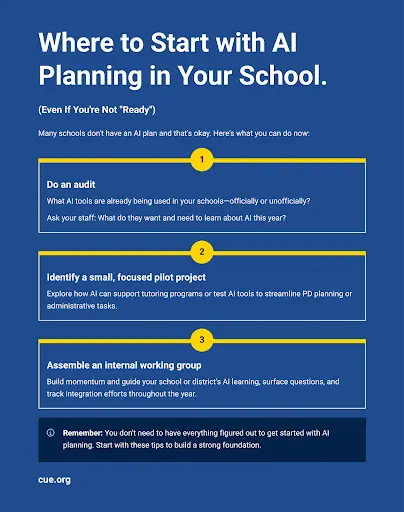
Where to Start (Even If You’re Not “Ready”)

Many schools don’t have an AI plan and that’s okay. Here’s what you can do now:

  • Do an audit: What AI tools are already being used in your schools—officially or unofficially?
  • Ask your staff: What do they want and need to learn about AI this year?
  • Identify a small, focused pilot project (AI in tutoring? PD workflow? Student media literacy unit?)
  • Assemble an internal working group to keep the conversation moving—and build momentum.

You don’t need a finished plan to make progress—these early actions help build staff awareness, build momentum toward AI literacy, and create a strong foundation for future planning.

What This Priority Could Mean for Funding & Strategy

This new federal priority lays the groundwork for future funding opportunities that will reward the districts already doing the work. That means this year’s efforts can double as strategy and grant prep.

Use this year to:

  • Document your teacher training efforts
  • Design programs that align with the proposed categories (dual enrollment, certifications, teacher prep, etc.)
  • Gather evidence of what’s working—those data points will matter when the next round of funding opens up

This new proposed priority from the U.S. Department of Education gives school leaders an opportunity to take a thoughtful, proactive approach to AI without rushing, overhauling everything, or getting lost in the buzz. You don’t need your staff to be an AI experts, you need to be clear about your goals for teaching and learning, and willing to ask how AI fits into that vision.

Start small and use the ideas in this post to:

  • Ground your team in a shared understanding of what AI literacy means.
  • Build confidence and clarity through targeted professional learning.
  • Create safe spaces for teachers to experiment, reflect, and collaborate.
  • Center your decisions on what’s best for students, not just what’s trending.

AI is already part of our world and school leadership isn’t about having all the answers—it’s about asking the right questions, bringing your educators into the conversation, and making intentional moves.

The U.S. Department of Education’s proposed priority offers a clear invitation for schools to lead this work with purpose and reflection. If you haven’t already, take a moment to review the proposal and consider submitting a comment at this link by selecting ‘public comments’ in the menu bar on the left. Your voice as a school leader matters in shaping how this policy supports the real work happening in classrooms every day.

  1. U.S. Department of Education. Proposed Priority and Definitions—Secretary’s Supplemental Priority and Definitions on Advancing Artificial Intelligence in Education. Federal Register, Vol. 90, No. 139, July 21, 2025, pp. 34203–34206. https://www.federalregister.gov/documents/2025/07/21/2025-13650 ↩︎