We are starting to hear a new phrase in education: the “science of writing.”
Like the science of reading and the science of math before it, the phrase is drawing attention to a body of research that has been developing for decades. Researchers including Arizona State University’s Steve Graham have studied how students become stronger writers, which instructional practices help, and how writing itself supports learning.
While the conversation around the “science of writing” is just beginning, here are some practical, research-informed ways educators can strengthen writing instruction right now.
Writing helps students do more than communicate what they know, it helps them think, reason, and make meaning. That matters even more in the age of AI.
AI is making the product easier. That makes the process more important.
Generative AI can brainstorm, outline, summarize, reorganize, revise, correct grammar, generate feedback, and produce polished text in seconds.
Those capabilities can absolutely support learners.
But they also create a new instructional design problem: sometimes the part AI makes easier is the exact part students needed to struggle with.
Planning an argument requires deciding what matters.
Selecting evidence requires judgment.
Writing an explanation requires organizing ideas.
Revising requires noticing the gap between what you intended to communicate and what a reader actually understands.
Those aren’t simply steps on the way to a finished essay. They are cognitive work.
A polished piece of writing and a developed writer are not necessarily the same thing.
So perhaps “Should students use AI for writing?” is no longer the most useful question.
A better one is: Where does the thinking live in this writing experience?
Decide what students should not outsource
Before deciding how students can use AI, identify the thinking you most want them to practice.
Try completing this sentence as you plan your students’ next writing task:
The part of this writing experience students most need to think through themselves is ____________________.
That one sentence can change how an assignment is designed.
If the goal is building an argument, students might develop their claim and evidence before using AI to challenge their reasoning.
If the goal is organization, AI might generate three possible structures—but students decide which one works best and explain why.
If the goal is revision, students might draft first, ask AI for feedback, and then evaluate which suggestions strengthen their meaning and which they reject.
If the goal is learning content, students might write an explanation from memory before comparing it with an AI-generated response.
In each case, AI is present, but the student still owns the thinking that matters.
Tomorrow, change one writing task—not your whole curriculum
You do not need a new writing program to start experimenting with this idea.
Take one task you already use and try one small shift:
- Write before AI. Give students two or three minutes to capture their own thinking before opening a tool.
- Make AI defend itself. Ask students to identify one AI suggestion they accepted, one they rejected, and why.
- Compare instead of copy. Have students compare their response with an AI response and identify what each does better.
- Expose the decisions. Ask students to annotate a final piece: Here is a choice I made as a writer and why I made it.
- Use AI as a reader. Instead of “rewrite this,” try: What is unclear to a reader? What questions does this leave unanswered?
These shifts move AI away from producing the answer and toward creating another opportunity to think.
The emerging conversation about the “science of writing” gives educators an opportunity to revisit what decades of research tell us about how writing develops.
AI gives us a new reason to do it now.
In the age of AI, the shift is to make the thinking inside the writing practices and routines we already use as educators even more intentional, while protecting the moments where students generate ideas, make choices, wrestle with meaning, and develop their own voice.
Want to go deeper?
Hear directly from Dr. Steve Graham on the Ms. Behaving in Literacy podcast, where he discusses current challenges, emerging insights, and what success can look like in literacy education.
Listen on Apple Podcasts | Listen on Spotify | Listen on YouTube
Audio overview of this article: Protecting_the_thinking_in_student_writing.m4a
Other News
 News
News
Small Wins, Better Technology
A school does not have to rewrite its entire technology plan to make meaningful progress.
 News
News
Two Organizations, One Question: What Does Every Learner Need?
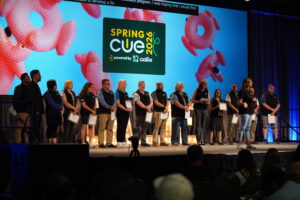
CAST and CALIE staff reflect on UDL-Con at Spring CUE 2026, what made the partnership work and why UDL matters more than ever for educators and learners.
 News
News
CALIE built a program. The graduates built something even bigger.
The inaugural cohort of CALIE Certified Educators crossed the finish line, and what they built along the way is worth...