Simple Steps for Crafting a District AI Policy: How to share this infographic with school leaders

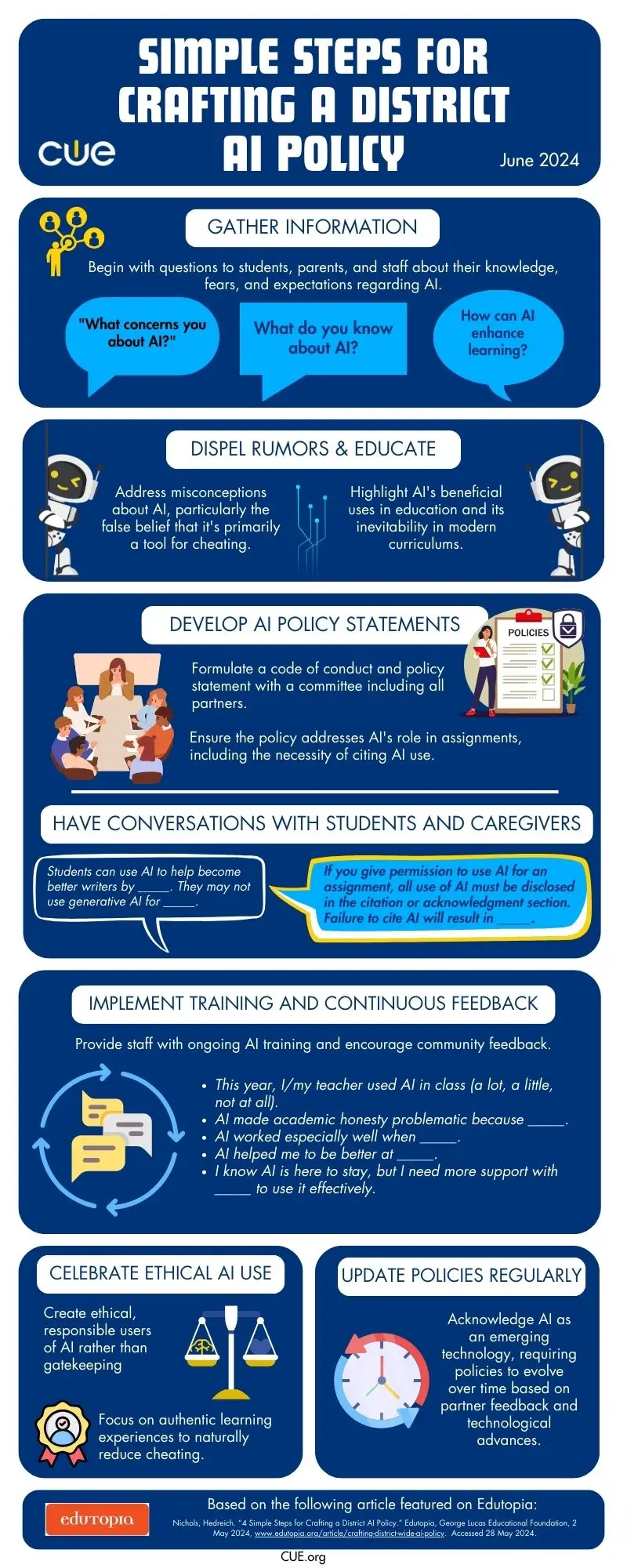
If you’ve been paying attention to how tech is transforming education this past year, you know AI is on the scene. It’s not just a buzzword anymore; it’s real, and it’s happening now. As exciting as it is, bringing AI into our schools isn’t just about flipping a switch. We need to be smart and strategic about it. Based on the Edutopia article, “4 Simple Steps for Crafting a District AI Policy,” this original CUE infographic includes tips covering everything from ethics to practical applications of AI.

Think about this infographic as a helpful conversation-starter to navigate the steps needed to develop policies in our AI world. It breaks down the complexities into manageable pieces, helping you and your leadership team understand concepts like data privacy, AI bias, and how to use these tools effectively. Feel empowered to discuss how AI has the potential to benefit everyone and align with your district’s mission and values. And feel free to remind your team that a strong and thoughtful policy will help avoid pitfalls like biased algorithms and security issues while promoting innovation.

So how can you get this information to the right people on your team? 

  • Distribute through Email: Email distribution can provide direct access to the infographic, allowing leaders to review and reflect on the content at their convenience. 

Here’s a sample AI Prompt for a related email that you can customize for your community:

  • You are an educator concerned about developing an AI policy for <your school district> but unable to draft the policy yourself. Compose an email to <your school leader> sharing an infographic that discusses simple steps to crafting a district AI policy. The email is the beginning of a conversation, so make sure the tone is <friendly, approachable, and action-oriented.> Offer to assist in the policy development and explain that you’re willing to meet to discuss this further.
  • Print Copies and Hand Them Out: Hand out printed copies of the infographic to your peers or drop it into their mailboxes. Having a printed copy of the resource on your desk can actually serve as a reminder to follow up about it and learn more.
  • Share at a Staff Meetings: Share the infographic during leadership meetings, weekly staff meetings, and professional development workshops. This opens up the floor for discussions and helps turn these ideas into action plans.

Get inspiration from these discussion stems and make them you own:

  • “A big takeaway from this infographic is how we need to think about ethical concerns, like…”
  • “To keep our district on the cutting edge with AI, we can use the tips in this infographic by…”
  • “Using the insights from this infographic in our plans, we can really boost our teaching methods by…”
  • “One key point is how we can use AI to better support our students’ learning needs, such as…”
  • “The infographic highlights the importance of involving caregivers in the AI policy process by…”

Discuss at a Personal Meeting: Make an appointment with your school leader/s and offer the infographic in advance. Making sure you both come to the meeting aware of the topic and the resource being shared increases confidence and creates a more comfortable starting place for discussion.

Find Someone to Share it on Your Behalf: Not in a position to meet with the school leaders who need this information? Seek out someone who can present it to the leadership team for you. Connecting with thought partners and advocates is a crucial step in building capacity.

You are already dialed into this important conversation by simply exploring this infographic. Now, you’re ready to spread this resource through multiple channels. Make sure you’ve done your part to ensure that everyone is prepared to use AI in a way that’s ethical, effective, and ultimately awesome for our students.
Top 5 Education Research Podcasts

Here are 5 educator podcasters who are also engaged in research or feature current researchers. These podcasts provide valuable insights into current educational research and its practical applications for educators.

1.  The Learning Scientists Podcast

This podcast focuses on evidence-based practice in education. Hosted by cognitive psychologists, it covers topics like learning theories and effective teaching strategies.

2. The Education Gadfly Show (Fordham Institute)

Discussions of recent education news, usually featuring Fordham’s Mike Petrilli and David Griffith. Then Amber Northern will recap a recent research study.

3. Meet the Education Researcher (Monash University)

Emerging issues and the latest ideas from across the world of education research. This is a monthly podcast that covers innovative research that will certainly expand your thinking.

4. Naylor’s Natter (Phil Naylor)

Phil Naylor’s podcast focuses on evidenced based teaching and features discussions with educators and researchers about the latest developments in teaching and learning. His episodes often highlight current research and its implications for classroom practice.

5. Truth for Teachers Podcast (Angela Watson)

Angela Watson provides actionable advice for teachers, often drawing from educational research to support her tips on classroom management, productivity, and teacher wellbeing.

Learning and Growing Together: The Power of Conferences to Ignite Personal and Professional Growth with Christine Feenstra, Executive Director of CUE

What is the current state of EdTech in schools?
How can integrating technology in teaching deliver positive outcomes?

Find out answers to these questions and more on the latest episode of Learning Through Technology.

Join Pacific One Source on their recent podcast episode as they connect with our own Christine Feenstra, Executive Director at CUE.

Insights from the podcast:

  • Discover how CUE plays a crucial role in helping schools and districts get a return on their technology investments.
  • Learn how professional learning, mentorship, and networking opportunities are key in driving educational outcomes.
  • Get ready for Spring CUE and discover how it fuels innovation and drives positive outcomes for educators.

Let Christine, along with hosts Alex and Bob, take you on a journey as they share stories of their favorite teachers and the impact they had on their education.

Thank you to Pacific One Source and ViewSonic for sponsoring the episode and helping to make the podcast possible!

Welcome to the CALIE Community

Educators are among the most powerful leaders in our state.
We create learning that matters, adapt to constant change, and inspire possibility every single day.

For more than four decades, the CUEmmunity harnessed that power by sharing ideas at conferences, learning from each other’s classrooms, and leaning on one another through times of change. We grew into a community of educators who believe in the power of innovation and in the strength that comes from not doing this work alone.

But innovation in education isn’t just about tools or technology. It’s about rethinking how schools adapt, how teachers lead, and how educators connect and support each other in the real work of teaching and learning.

That’s why we evolved. CUE is now CALIE: the California Association for Leading Innovation in Education.

CALIE exists to give teachers, school leaders, and innovators the confidence, tools, and experiences to design classrooms and schools that really work for today’s learners, while also amplifying their professional and leadership goals.

Our Belief

We believe in the power of educators.
We are the local leaders sparking meaningful learning, even when the challenges are tough.
We push big ideas forward,
We lean on each other for support

We know that innovation in education is about people, not just technology.
It’s about using innovation to break down barriers to learning.
It’s about unlocking potential.

And we believe that together, anything is possible.

What’s Ahead

CALIE’s expanded mission and vision makes it possible for us to do more to support, inspire, and empower more educators than ever before. Over the next year you’ll gain new ways to learn, lead, and connect, including:

  • The CALIE Certified Educator Program builds skills in instructional design, educational technology, and schoolwide improvement strategies, preparing you to drive change wherever your career takes you.
  • The CALIE AI Leadership Academy empowers educators and school leaders to build knowledge, skills, and strategies for ethical, impactful integration of artificial intelligence in education.
  • A stronger statewide network that makes sure you are heard, supported, and inspired.

Whether you’ve been with us for years or you’re just discovering this community, we’re glad you’re here.

Welcome to CALIE. Let’s spark meaningful learning, together.

When Everything Feels Uncertain, Educator Connection Should Be Non-Negotiable

Across the country, educators are navigating growing complexity—rising student needs, shifting expectations, and inconsistent support. Recent reporting from Education Week1 highlights these concerns, capturing how stress, burnout, and a loss of connection are keeping teachers up at night. But these aren’t just individual struggles—they’re symptoms of systems not built for the realities of today’s classrooms. And we recognize that for many districts, when resources are stretched thin, even essential supports can feel just out of reach—but listening to educators and elevating their voices can reveal powerful, often untapped, solutions

But amidst the weight of it all, one truth remains clear, 

Educators flourish when they learn from each other.

Just as students learn best through connection and collaboration, teachers do too. The most effective professional learning doesn’t happen in isolation—it grows in community. It’s in the hallway conversations, shared lesson ideas, and moments of collective problem-solving that real transformation begins.

In a time when federal professional development funds are frozen—when budgets are tight, and uncertainty feels constant—we can’t let connection be the first thing we cut.

At CUE, we’ve known this for over 45 years. And we believe more than ever: Community is not a luxury. It’s essential infrastructure and teachers need more than PD, they need each other.

Resourceful Doesn’t Have to Mean Resourced

Yes, the freeze on federal Title II-A funds for teacher development is real, and yes, it impacts districts across the country. But it doesn’t have to mean the end of meaningful support.

Even when budgets are already allocated, creativity within existing structures can open doors. Decision-makers can explore how to braid funds from Title I or IDEA to support collaboration time or instructional coaching. Rural education and school improvement grants may offer flexibility to fund peer mentoring or cross-site networks. And Title IV-A rollover dollars can be leveraged for tech integration projects—especially those rooted in educator-led inquiry and innovation.

Of course, every district’s funding picture looks different—and repurposing dollars requires thoughtful alignment with each program’s goals. But with creative planning and a strong case for impact, there are still pathways forward

Just as importantly, schools can reimagine how time is used—not just how funds are spent.

  • Build in time for structured collaboration during the school day.
  • Support peer mentoring and cross-role coaching.
  • Create shared planning routines that encourage reflection, experimentation, and problem-solving.
  • Recognize the power of informal learning networks, not just formal professional development.

Connection doesn’t require a massive budget. But it does require commitment.

Connection Is a Cornerstone of Learning

A well-supported, connected educator isn’t just more likely to stay—they’re more likely to reflect, innovate, and adapt instruction in ways that meet the moment. When teachers feel seen, heard, and uplifted by their peers, that energy ripples outward. It reaches classrooms and students.

We can’t afford to wait for the perfect funding cycle. We have to lead with what we already know: Investing in educator connection is one of the most powerful, low-cost strategies we have. In times of constraint, we may have to do less overall, but we can protect what matters most.

How CUE Can Help

We know school leaders are balancing enormous pressures—academic recovery, staff burnout, shrinking budgets, and rising expectations. In that landscape, finding time and resources to support professional learning can feel nearly impossible. The choices leaders face aren’t about what’s ideal—they’re about what’s sustainable, impactful, and equitable under real-world conditions.

At CUE, we don’t just believe in educator connection, we build the structures for it. This has always been the place where educators come to connect, learn, and grow—together. We help schools support the people at the heart of the system: educators. 

If you’re a leader looking for ways to support your educators with meaningful, lasting connection, we’d love to talk. CUE membership is one of the simplest ways to keep your team inspired, informed, and part of something bigger. Reach out to explore how you can bring your educators into the CUE community—and lead the kind of change that lasts.

  1. Arianna Prothero & Vanessa Solis. “The Top 10 Things That Keep Teachers Up at Night.” Education Week, November 26, 2024. https://www.edweek.org/teaching-learning/the-top-10-things-that-keep-teachers-up-at-night/2024/11 ↩︎

Federal STEM Plan: A Call to Action for California Educators

The newly released Federal Strategic Plan for Advancing STEM Education and Cultivating STEM Talent is a powerful roadmap for strengthening science, technology, engineering, and math (STEM) across the nation. This five-year plan emphasizes the importance of collaboration, accessibility, and innovation, providing a framework that educators, administrators, and leaders can act on to prepare students for the opportunities of the future.

For California educators and teacher leaders, this plan directly aligns with the ongoing work to close opportunity gaps, engage students in STEM-rich experiences, and equip schools to prepare students for thriving in a rapidly changing world. At CUE, we see this as a pivotal moment to reflect on our shared goals and align our strategies to this national vision.

5 Key Takeaways for Educators

1. Engage Students and Communities in STEM

  • The plan emphasizes the need to inspire learners of all ages by connecting STEM to real-world applications and fostering a sense of belonging.
  • Take Action: Host STEM nights, integrate community-driven projects, or engage students in media creation and storytelling using STEM tools.

2. Strengthen STEM Teaching and Learning

  • Addressing disparities in STEM education is critical. Building a diverse and well-prepared STEM teacher workforce is central to this goal.
  • Take Action: Advocate for and participate in professional development opportunities focusing on inclusive practices, AI literacy, and emerging technologies.

3. Prepare the Future Workforce

  • Cultivating a robust STEM talent pipeline ensures students are equipped for careers in high-demand fields like data science, sustainable engineering, and cybersecurity.
  • Take Action: Introduce career exploration activities, connect students with mentors in STEM fields, and integrate career-aligned STEM pathways into curricula.

4. Expand STEM Research and Innovation

  • Cutting-edge STEM education research and innovation are essential to staying competitive. California’s schools and teacher leaders can drive local solutions to national challenges.
  • Take Action: Collaborate with universities or organizations to implement and evaluate new instructional strategies and share your findings.

5. Foster Inclusive and Supportive STEM Environments

  • Removing barriers to participation and retention in STEM is essential for ensuring equity.
  • Take Action: Implement Universal Design for Learning (UDL) principles, support underrepresented students in STEM programs, and advocate for policies that enhance accessibility.

Why This Matters for California Educators

The federal STEM plan recognizes the diversity of learners and communities across the U.S. and the need for inclusive, localized solutions. California’s educators are uniquely positioned to lead the way in implementing these strategies, thanks to the state’s rich diversity, innovative spirit, and strong commitment to equity in education. With a focus on preparing students for AI, clean energy, and other emergent fields, California can set a national example.

Let’s Get to Work

The Federal Strategic Plan is more than a document—it’s a call to action for all of us in education. We would love to see how you are taking any of these actions or if you have any other ideas for advancing STEM education and cultivating STEM talent.

Please share your thoughts in the comments!

Leading the Way: Media Literacy for EdTech Leaders

Join us for the 10th Annual U.S. Media Literacy Week, hosted by NAMLE (National Association for Media Literacy Education) from October 21-25! As tech leaders in your schools and districts, you already understand the importance of integrating innovative tools into your teaching. Media literacy is a crucial component of preparing students to critically analyze information and navigate the digital landscape with confidence.

Here’s how you can enhance your edtech practices and make media literacy a powerful tool in your classroom:

NAMLE (National Association for Media Literacy Education)

  • What It Offers: NAMLE, the official host of Media Literacy Week, provides an array of resources, including videos, webinars, and toolkits, all designed to help teachers incorporate media literacy into their lessons. They also host the Media Literacy Resource Showcase during the week, where educators can explore the latest tools and strategies for teaching these critical skills.
  • Free Teacher Accounts: No account is necessary, and many of NAMLE’s resources, webinars, and events are freely accessible on their website.
  • Why It’s Great for Innovators: NAMLE’s comprehensive materials support you in staying ahead of the curve, offering cutting-edge strategies and resources to integrate media literacy seamlessly into your technology-rich classroom.

AllSides for Schools

  • What It Offers: AllSides for Schools provides a Media Bias Chart and curated news stories from across the political spectrum, helping students compare diverse perspectives on the same issue. This resource can be easily integrated into your existing digital curriculum to promote critical thinking and nuanced discussion in the classroom.
  • Free Teacher Accounts: Yes, AllSides offers free teacher accounts, giving you access to lesson plans, discussion guides, and a range of interactive media bias tools.
  • Why It’s Great for Innovators: You can use AllSides to create interactive lessons where students analyze bias using digital tools, enhancing their media literacy skills while promoting digital age thinking.

Checkology by the News Literacy Project

  • What It Offers: Checkology is an interactive platform that guides students through real-world scenarios to teach them how to recognize misinformation, evaluate sources, and understand the role of the media in a democracy. It’s an ideal resource for tech leaders who want to add more immersive, student-led learning experiences to their classroom.
  • Free Teacher Accounts: Yes, Checkology offers free accounts with access to most of its core media literacy lessons.
  • Why It’s Great for Innovators: Checkology’s gamified learning modules allow students to engage in simulations where they become media detectives, building crucial literacy skills while leveraging your classroom’s technology tools.

How This Supports Your Innovative Teaching Practices:

  • AllSides For Schools and Checkology both integrate seamlessly with the digital tools and learning management systems you’re already using, enabling you to enhance student engagement and create dynamic, interactive lessons.
  • By incorporating these media literacy tools, you’ll empower students to become critical thinkers and responsible digital citizens, preparing them for the challenges of a tech-driven world.
  • These resources promote student-centered learning, allowing you to facilitate discussions that foster a deeper understanding of the digital media landscape.

ISTE DigCit Competencies

In today’s digital world, every school needs a robust digital citizenship program to ensure students are safe, responsible, and proactive online. The ISTE Digital Citizenship Competencies are a great starting point, shifting the focus from what students shouldn’t do to empowering them with the skills and mindset to become thoughtful, empathetic digital citizens. By incorporating these competencies alongside media literacy tools like AllSides and Checkology, educators can create a holistic approach to teaching students how to navigate, evaluate, and contribute to the digital world. Explore ISTE’s comprehensive resources here.

Leverage these powerful tools during Media Literacy Week to inspire students to critically engage with the world around them while furthering your innovative teaching practices. Let’s continue to lead the way in digital education this October!

Secure Your Communication: Cybersecurity Tips for Educators

June is National Internet Safety Month

As your schedule becomes more personalized and less tethered to your school or home internet networks, it’s a good idea to take a moment and review some best practices when it comes to keeping you and your communication safe and secure. Ensuring email security is crucial to protect student information and maintain trust within the educational community. It’s also just as important to understand the basic concepts of cybersecurity. 

Here are some essential security tips and resources for educators to consider and explore as you launch into summer vacation.

CALIE
CALIE

1. Create Strong, Unique Passwords

A strong password is your first line of defense against unauthorized access. Use a combination of upper and lower case letters, numbers, and special characters. Avoid using easily guessable information, such as birthdays or common words. Consider using a password manager to generate and store unique passwords for each account securely.

PRO TIP: Use tools like www.random.org’s Random Password Generator to help keep your passwords fresh and safe. 

2. Recognize Phishing Attempts

Phishing emails attempt to trick you into revealing personal information or clicking on malicious links. Be wary of emails from unknown senders or those that create a sense of urgency. Look for red flags such as poor grammar, suspicious attachments, or links that don’t match the sender’s domain. If in doubt, verify the email’s legitimacy by contacting the sender directly through a trusted communication channel.

PRO TIP: Try your hand at practicing to identify phishing attempts through the Google Phishing Quiz powered by Jigsaw.

CALIE

3. Understand Cybersecurity and Have Fun Doing It

Cybersecurity is crucial for all users and educators in 2024 because the increasing reliance on digital tools and online platforms makes us more vulnerable to cyber threats. Protecting sensitive information, such as student data and personal details, is essential to maintain trust and privacy. Additionally, understanding cybersecurity helps educators create a safe learning environment and empowers students to navigate the digital world securely.

PRO TIP: Understand cybersecurity by playing Cyber Awareness Challenge by the US Department of Defense. This engaging, interactive game helps you navigate various scenarios, including email safety, ensuring you learn vital cybersecurity skills in an enjoyable and memorable way. 

During National Internet Safety Month, remember to take the lead and help safeguard your communication and protect the sensitive student information you handle daily. Prioritizing cybersecurity not only protects you but also fosters a safe and trustworthy educational environment for everyone involved.